

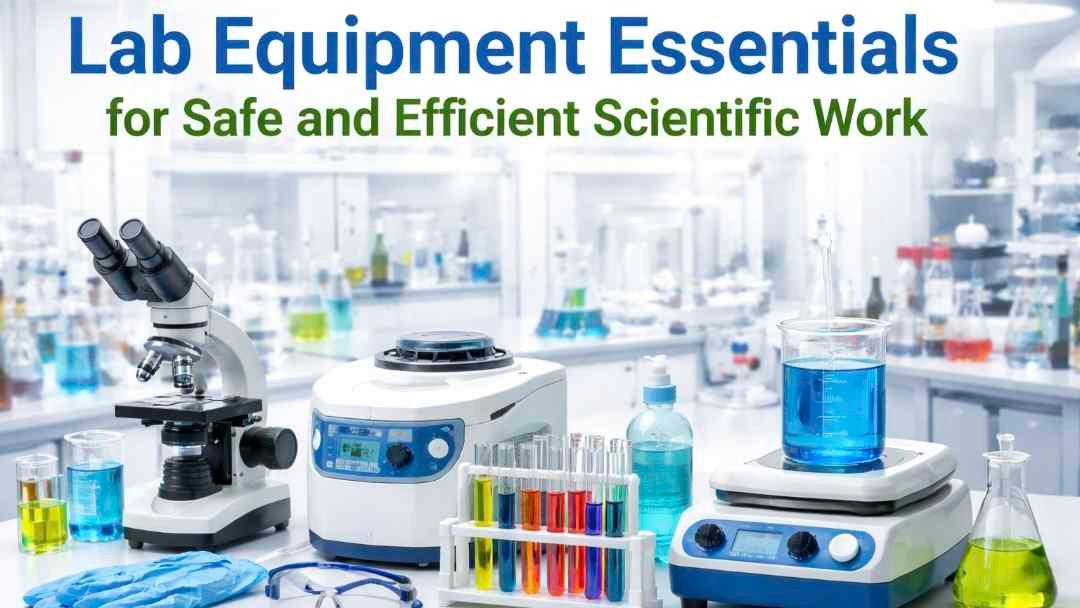
You rely on lab equipment to get accurate, repeatable results, whether you run experiments, manage a classroom, or maintain a quality-control line. Choose the right tools and use them correctly, and you cut errors, save time, and protect everyone working in the space.
This article shows which types of equipment matter for common lab tasks and explains practical steps for proper use and routine maintenance so your instruments perform reliably. Follow clear guidance on selection, safe operation, and basic upkeep to keep your work precise and your costs down.
Types of Lab Equipment
You will encounter instruments for handling samples, containers and transfers, and devices for measuring composition and properties. Each group contains items chosen for accuracy, safety, and repeatability in typical lab workflows.
General Laboratory Instruments
These are tools you use daily to prepare, move, and control experiments. Common items include micropipettes (single- and multi-channel) for precise liquid handling, vortex mixers and tube rotators for sample mixing, and balances (analytical and top-loading) for mass measurements.
You will also rely on heat sources such as hot plates, Bunsen burners, and dry baths for controlled heating. Temperature control equipment like incubators and refrigeration units preserves samples and cultures at set temperatures.
Safety and ergonomics matter: fume hoods protect you from vapors, biosafety cabinets shield biological work, and eye/hand protection stores should be accessible. Calibrate pipettes and balances regularly and follow maintenance schedules to retain accuracy.
Glassware and Plasticware
Choose glass or plastic based on chemical compatibility, temperature needs, and sterility. Typical glassware includes beakers, Erlenmeyer flasks, volumetric flasks, graduated cylinders, and burettes for mixing, titration, and precise volume measurements. Borosilicate glass offers high thermal and chemical resistance.
Plasticware like polypropylene and polystyrene tubes, microplates, and disposable pipette tips reduce breakage risk and contamination. Use sterile, disposable options for cell culture and PCR to prevent nucleic acid or microbial carryover.
Label containers clearly and use appropriate caps or septa to maintain sample integrity. Inspect glass for chips and plastic for warping; replace compromised items to avoid measurement errors or contamination.
Analytical Equipment
Analytical instruments determine composition, concentration, and physical properties. Key bench instruments include spectrophotometers (UV-Vis) for absorbance-based quantification, pH meters for solution acidity, and conductivity meters for ionic strength.
More advanced tools cover chromatography (HPLC, GC) for separating compounds, mass spectrometers for molecular identification, and atomic absorption or ICP instruments for elemental analysis. Choose detectors and columns based on target analytes and required sensitivity.
Routine calibration with standards and running blanks are essential to validate results. Consider software, consumables (columns, lamps, reagents), and service contracts when selecting analytical equipment to ensure long-term performance.
Proper Use and Maintenance of Laboratory Equipment
You must keep instruments accurate, clean, and safe to protect data integrity and personnel. Regular calibration, routine cleaning, proper storage, and adherence to safety protocols minimize downtime and prevent accidents.
Calibration and Quality Control
You should establish a calibration schedule for each instrument based on manufacturer recommendations and usage frequency. Record the date, technician, procedure, and results in a calibration log or LIMS to provide traceability for audits and troubleshooting.
Use certified reference materials or standards that match the instrument’s measurement range. Perform checks at startup, after major repairs, and whenever results deviate from expected values. Implement routine quality control (QC) runs—include blanks, standards, and control samples—and set acceptance criteria for pass/fail decisions.
When an instrument fails QC, stop using it for data production. Follow a defined corrective action workflow: isolate the instrument, notify responsible personnel, run diagnostic tests, and document repairs. Recalibrate and verify performance with QC samples before returning the instrument to service.
Cleaning and Storage Procedures
Follow manufacturer cleaning instructions and approved detergents or solvents to avoid damaging components or altering performance. Use lint-free wipes, appropriate brushes, and filtering when rinsing to prevent particulate contamination.
Create written cleaning schedules that specify daily, weekly, and monthly tasks for benchtop devices, glassware, and auxiliary equipment. Label cleaned and sanitized items with date and the responsible person’s initials. For sensitive optics or sensors, use dust covers and desiccant packs when storing.
Store chemicals, reagents, and consumables in temperature- and humidity-controlled cabinets. Segregate corrosive or reactive substances from electronic equipment. Use clear inventory controls—first-expire, first-out (FEFO)—to prevent degraded reagents from compromising results.
Safety Practices
Wear required personal protective equipment (PPE) matched to the hazard: gloves, goggles, lab coat, and face shields for splash risks. Ensure eyewash stations and safety showers are accessible and tested regularly.
Review and follow standard operating procedures (SOPs) for each instrument before use. Post hazard labels and emergency contact info near high-risk equipment. Verify electrical connections, grounding, and ventilation for instruments that generate heat, fumes, or aerosols.
Train personnel on safe handling, spill response, and lockout/tagout procedures for Lab Equipment Essentials for Safe and Efficient Scientific Work
You rely on lab equipment to get accurate, repeatable results, whether you run experiments, manage a classroom, or maintain a quality-control line. Choose the right tools and use them correctly, and you cut errors, save time, and protect everyone working in the space.
This article shows which types of equipment matter for common lab tasks and explains practical steps for proper use and routine maintenance so your instruments perform reliably. Follow clear guidance on selection, safe operation, and basic upkeep to keep your work precise and your costs down.
Types of Lab Equipment
You will encounter instruments for handling samples, containers and transfers, and devices for measuring composition and properties. Each group contains items chosen for accuracy, safety, and repeatability in typical lab workflows.
General Laboratory Instruments
These are tools you use daily to prepare, move, and control experiments. Common items include micropipettes (single- and multi-channel) for precise liquid handling, vortex mixers and tube rotators for sample mixing, and balances (analytical and top-loading) for mass measurements.
You will also rely on heat sources such as hot plates, Bunsen burners, and dry baths for controlled heating. Temperature control equipment like incubators and refrigeration units preserves samples and cultures at set temperatures.
Safety and ergonomics matter: fume hoods protect you from vapors, biosafety cabinets shield biological work, and eye/hand protection stores should be accessible. Calibrate pipettes and balances regularly and follow maintenance schedules to retain accuracy.
Glassware and Plasticware
Choose glass or plastic based on chemical compatibility, temperature needs, and sterility. Typical glassware includes beakers, Erlenmeyer flasks, volumetric flasks, graduated cylinders, and burettes for mixing, titration, and precise volume measurements. Borosilicate glass offers high thermal and chemical resistance.
Plasticware like polypropylene and polystyrene tubes, microplates, and disposable pipette tips reduce breakage risk and contamination. Use sterile, disposable options for cell culture and PCR to prevent nucleic acid or microbial carryover.
Label containers clearly and use appropriate caps or septa to maintain sample integrity. Inspect glass for chips and plastic for warping; replace compromised items to avoid measurement errors or contamination.
Analytical Equipment
Analytical instruments determine composition, concentration, and physical properties. Key bench instruments include spectrophotometers (UV-Vis) for absorbance-based quantification, pH meters for solution acidity, and conductivity meters for ionic strength.
More advanced tools cover chromatography (HPLC, GC) for separating compounds, mass spectrometers for molecular identification, and atomic absorption or ICP instruments for elemental analysis. Choose detectors and columns based on target analytes and required sensitivity.
Routine calibration with standards and running blanks are essential to validate results. Consider software, consumables (columns, lamps, reagents), and service contracts when selecting analytical equipment to ensure long-term performance.
Proper Use and Maintenance of Laboratory Equipment
You must keep instruments accurate, clean, and safe to protect data integrity and personnel. Regular calibration, routine cleaning, proper storage, and adherence to safety protocols minimize downtime and prevent accidents.
Calibration and Quality Control
You should establish a calibration schedule for each instrument based on manufacturer recommendations and usage frequency. Record the date, technician, procedure, and results in a calibration log or LIMS to provide traceability for audits and troubleshooting.
Use certified reference materials or standards that match the instrument’s measurement range. Perform checks at startup, after major repairs, and whenever results deviate from expected values. Implement routine quality control (QC) runs—include blanks, standards, and control samples—and set acceptance criteria for pass/fail decisions.
When an instrument fails QC, stop using it for data production. Follow a defined corrective action workflow: isolate the instrument, notify responsible personnel, run diagnostic tests, and document repairs. Recalibrate and verify performance with QC samples before returning the instrument to service.
Cleaning and Storage Procedures
Follow manufacturer cleaning instructions and approved detergents or solvents to avoid damaging components or altering performance. Use lint-free wipes, appropriate brushes, and filtering when rinsing to prevent particulate contamination.
Create written cleaning schedules that specify daily, weekly, and monthly tasks for benchtop devices, glassware, and auxiliary equipment. Label cleaned and sanitized items with date and the responsible person’s initials. For sensitive optics or sensors, use dust covers and desiccant packs when storing.
Store chemicals, reagents, and consumables in temperature- and humidity-controlled cabinets. Segregate corrosive or reactive substances from electronic equipment. Use clear inventory controls—first-expire, first-out (FEFO)—to prevent degraded reagents from compromising results.
Safety Practices
Wear required personal protective equipment (PPE) matched to the hazard: gloves, goggles, lab coat, and face shields for splash risks. Ensure eyewash stations and safety showers are accessible and tested regularly.
Review and follow standard operating procedures (SOPs) for each instrument before use. Post hazard labels and emergency contact info near high-risk equipment. Verify electrical connections, grounding, and ventilation for instruments that generate heat, fumes, or aerosols.
Train personnel on safe handling, spill response, and lockout/tagout procedures for maintenance. Keep a maintenance log that includes safety checks and incident reports to inform risk reduction and future training.. Keep a maintenance log that includes safety checks and incident reports to inform risk reduction and future training.