

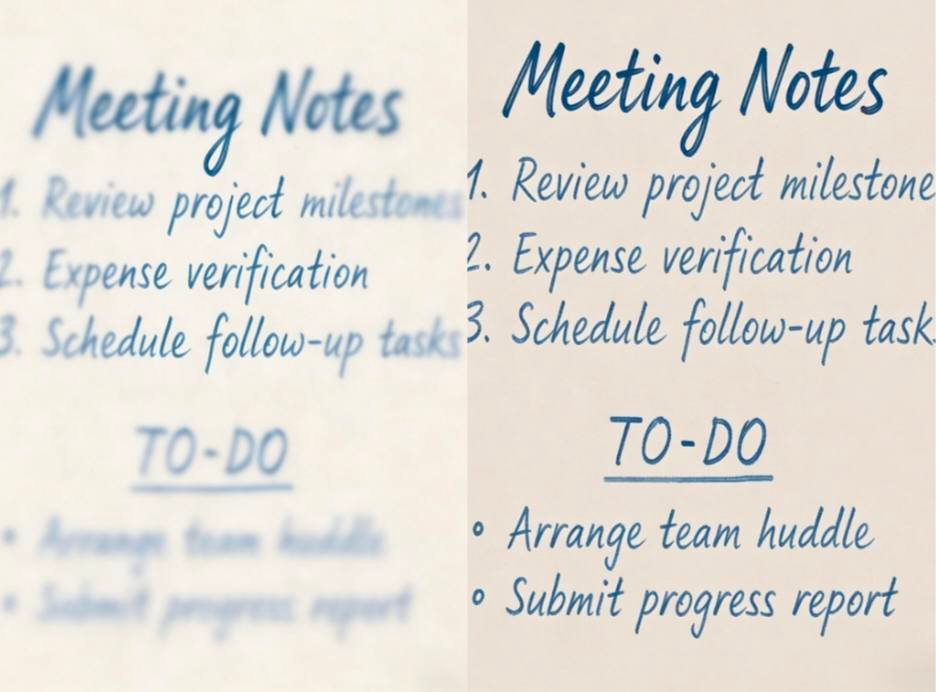
Low-quality CCTV footage can be a major roadblock in an investigation. A critical piece of information, like a license plate number or text on a sign, is often lost in a blur of pixels and motion. What was meant to provide clarity instead creates frustration. Fortunately, modern AI tools can now act as a powerful forensic assistant, sharpening blurry images to reveal hidden details.
These tools can make unreadable text legible, turning a dead-end clip into a source of actionable evidence. This post explores the practical, real-world scenarios where an AI-powered tool like Unblur Image can be used to decipher crucial text from low-quality CCTV frames. We’ll cover how this technology works and provide a simple workflow to help you recover the information you need.
Real-World Scenarios for Deciphering CCTV Text
Blurry text is a common problem, but the context in which it appears can vary greatly. From criminal investigations to simple security reviews, clarifying text can provide the missing piece of the puzzle. Here are three common situations where AI image enhancement makes a significant difference.
Use Case 1: Identifying a Vehicle of Interest
One of the most frequent challenges in analyzing security footage is identifying a vehicle from its license plate. Whether it’s a hit-and-run, a theft, or a car involved in trespassing, the license plate is often the most direct link to the owner. However, cameras installed at a distance, in poor lighting, or with low resolution often capture plates as indistinct white or yellow rectangles.
Imagine a scenario where a business owner’s parking lot is used for illegal dumping overnight. The security camera catches the truck, but the license plate is completely unreadable due to motion blur as the vehicle pulls away. Without a plate number, law enforcement has little to go on. By extracting the clearest possible frame from the video and using an AI tool, the owner can sharpen the image. The AI algorithms analyze the pixel patterns, reduce the blur, and reconstruct the characters, often making the plate number clear enough to report. This single piece of information can lead to identifying the culprit and resolving the case.
Use Case 2: Reading Text on Clothing and Belongings
Identifying a person of interest is about more than just facial recognition, which is often impossible with grainy footage. The text on a person’s clothing or backpack can provide invaluable clues about their identity, employment, or affiliations. A company logo, a name on a uniform, or a slogan on a shirt can help investigators narrow down a search from thousands of people to a handful.
Consider a case of shoplifting where the suspect’s face is obscured by a hat and poor camera angles. However, their jacket has a small, blurry logo on the chest. To the naked eye, it’s just a smudge. By isolating and enhancing that specific area of the frame, investigators could clarify the logo of a local delivery service or construction company. This technique is similar to the digital processes used in Old Photo Restoration, where faded details are brought back to life. This lead allows authorities to follow up with the company, check employee records, and potentially identify the individual involved.
Use Case 3: Clarifying Important Signage or Documents
Sometimes the crucial text isn’t on a moving object but is part of the environment or an item in someone’s possession. This could be a street sign that establishes a location, the name of a business in the background, or even text on a document a person is holding. When this text is pixelated, a key piece of context is lost.
For instance, a security camera might capture a person of interest near a row of businesses, but the names on the storefronts are too blurry to read. This makes it difficult to pinpoint their exact location or the businesses they interacted with. By enhancing the frames, the names of the stores can be revealed, helping to create a more precise timeline of events. In another scenario, footage might show a person holding a piece of paper. While the entire document won’t be readable, an AI tool could potentially clarify a headline, a logo, or a large-print title, offering a clue about the document’s nature and purpose.
Benefits of AI-Powered Text Clarification
Using AI to unblur text in CCTV frames offers distinct advantages across different scenarios. These benefits transform video footage from a passive recording into an active source of intelligence.
For vehicle identification, the primary benefit is generating actionable leads. A blurry license plate is a dead end, but a clarified one gives law enforcement a concrete number to run through databases. This is critical for resolving hit-and-runs, identifying getaway cars in thefts, and enforcing parking or trespassing violations. It can also be essential for insurance claims, providing the proof needed to hold the correct party accountable.
When it comes to identifying people, the benefits are about context and association. Reading text on clothing or a bag helps build a profile. It can connect an individual to a workplace, a school, or a specific group. This narrows the pool of suspects and gives investigators a new direction to pursue. It turns an anonymous figure into someone with potential connections, making them far easier to locate.
Finally, clarifying text on signs and documents provides crucial environmental context. Knowing the exact street or business name can verify a subject’s location and timeline. It can help corroborate or disprove alibis. Deciphering text on a document, even partially, can offer insights into a person’s intent or activities. These details add layers to an investigation that would otherwise be missing.
A Practical Workflow for Unblurring CCTV Text
Recovering text from blurry footage doesn’t require a high-tech forensics lab. With the right tool and a simple process, you can significantly improve your chances of deciphering the information you need.
Step 1: Extract the Clearest Frame
The first step is to carefully review the video and isolate the single best frame. Scrub through the footage frame by frame to find the moment the text is least distorted. Even a marginal improvement in clarity can make a huge difference for the AI. Once you’ve found the best option, export it as a high-quality image file, such as a PNG or JPG.
Step 2: Crop the Area of Interest
Instead of uploading the entire video frame, crop the image to focus only on the area containing the text. For example, if you are trying to read a license plate, create a new image that contains only the plate. This directs the AI’s processing power to the most important part of the image, which often leads to a more accurate and detailed result. It also removes distracting visual noise from the rest of the scene.
Step 3: Upload and Process with an AI Tool
With your cropped image ready, navigate to an AI image enhancement tool. The process is typically straightforward: upload your image and let the AI work. The tool will analyze the image for blur, noise, and pixelation, applying algorithms to sharpen edges and reconstruct the original characters. This usually only takes a few moments.
Step 4: Analyze and Iterate
The AI will present you with the enhanced image. In many cases, the text will now be legible. However, if it’s still not perfectly clear, don’t give up. Go back to your original video and look for another frame to try. Sometimes a frame from a slightly different angle or a split second later can yield a better result. Experiment with different crops and frames to maximize your chances of success.
Conclusion
Blurry text in CCTV footage no longer has to be an investigative dead end. The accessibility of AI-powered image enhancement tools gives business owners, security professionals, and even individuals the ability to recover information once thought to be lost. By sharpening license plates, clarifying text on clothing, and reading distant signs, you can uncover the critical leads needed to solve problems.
The use cases are clear: from identifying vehicles in criminal acts to placing a person of interest at a specific location, the ability to read blurry text is a powerful advantage. By following a simple workflow of extracting, cropping, and enhancing, you can turn grainy footage into a source of clear, actionable intelligence.