

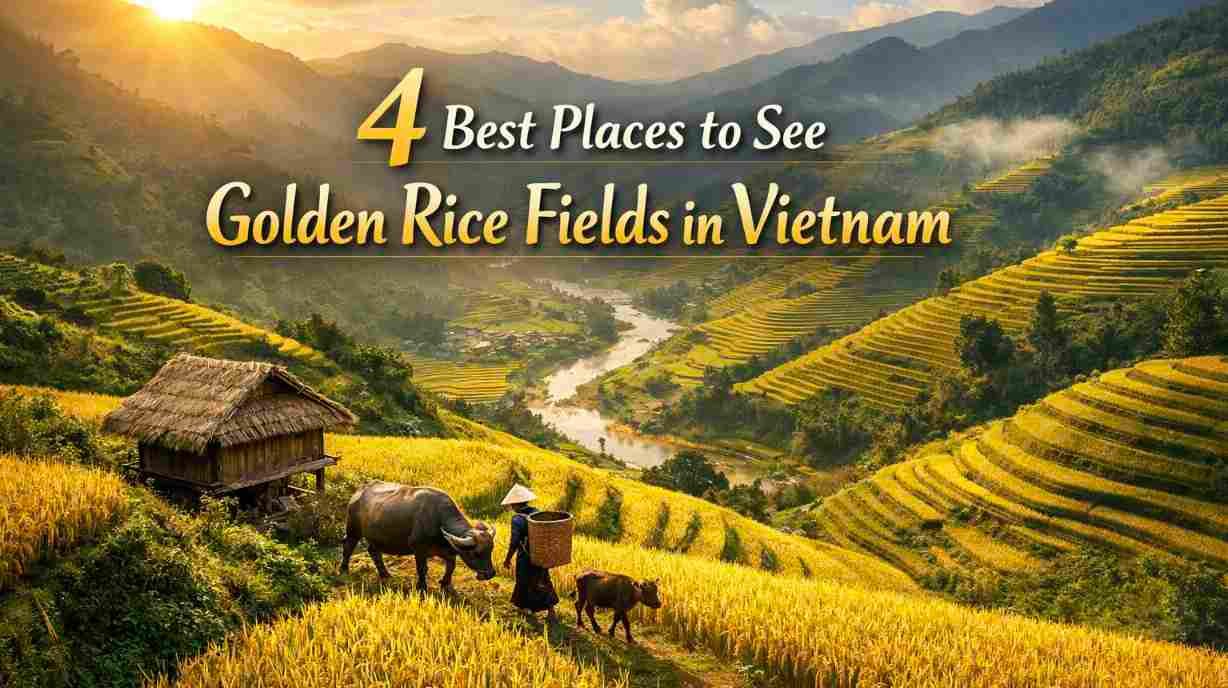
Every year, during several weeks, Vietnam is subjected to a transformation that photographers and nature tourists base their whole trips on. During the period between mid-September and early October, the rice paddies and terraces of the mountains, which characterize so much of the scenery of the land, are turned to a fiery, radiant gold, creating the famous Golden rice fields in Vietnam across many Northern Vietnam landscapes. The harvesting season in Vietnam is very short, though it is one of the most spectacular viewing seasons of travel in the country throughout the year, attracting travelers planning Vietnam vacation packages and scenic Vietnam country tour itineraries.
The Reason September and October are the Goodest Months to Visit
Vietnamese culture and economy have been influenced by rice farming for thousands of years. Vietnam does not only have a harvest season but also a working season in the villages. Fields that grow during the summer months are clipped out by hand, bound, and transported on narrow dikes. Seeing this process occur over a whole valley with the terraces shining gold is the type of experience that will be remembered by the travelers even long after the guide has been left, particularly during harvest season in Vietnam, which defines the beauty of September and October Vietnam travel.
Tam Coc, Ninth Binh: Fields of Gold at River Level
About 100km south of Hanoi, Tam Coc Ninh Binh is on the southern border of the Northern rice field circuit and also presents an opportunity that the mountain destinations do not provide; the opportunity to witness the Golden harvesting season in Vietnam at water level. The Tam Coc boat trip follows the Ngo Dong River in a valley between the limestone mountains, and when the rice paddies on both sides have changed to gold during the month of October, the picture seen from the boat is amazing and ranks among the best places to visit in Vietnam.
- Best for:
Those travelers who desire the rice field experience, but without the long mountain drive. Tam Coc is paired with a Hanoi base, and the country tour to Vietnam fits well naturally into a Sapa trip up north afterwards, often included in organized Vietnam trip package itineraries. - Local tip:
Riding on the countryside tracks and riding to the Mua Cave scenery will provide a high level of scenery of the rice fields that cannot be offered by the boat tour only. One of the more effective methods of spending an afternoon in the area is going on a bicycle around the various villages.
Bac Son Valley, Vietnam: The Hushpuppy Land
Bac Son Valley is another location that is truly not on the main tourist route and is located about 250 kilometres northeast of Hanoi. Limestone ridges part, and the mosaic of fields that can be viewed in the Na※ Mountain view of the valley located above it, makes the patchwork of fields the most photogenic landscape in the northern part of Vietnam. The old village houses, winding rivers, lack of crowd, and so on make Bac Son a place that is worthy of those who are ready to go a little bit off the track and discover hidden Vietnam photography spots.
Best for:
Travelers who are interested in photography and travellers on a Vietnam eco tour package itinerary in search of the authentic rural experience among ethnic minority villages, but want to avoid being part of a large group. The topography is rather open and less steep than the steep terraces of Sapa and Mu Cang Chai.
Getting there:
Bac Son can be conveniently approached by private car or motorbike, either from Lang Son or Hanoi. It is naturally matched by Ha Giang as an extension of a north-east Vietnam loop.
Sapa: The Vietnamese Rice terraces, which are the most famous
The first picture that most tourists get when they look at the golden rice fields in Vietnam is the Sapa rice terraces, and the reality does not disappoint. Muong Hoa Valley terraces are formed by the layers of steep mountain slopes that took generations of Hmong and Dao farmers to build, creating the iconic terraced rice fields landscapes that define rice terraces in Vietnam.
- Best for:
Cultural travelers, trekkers, and everyone looking to have a mixture of photography destinations in Vietnam and experience the village life. Sapa is accessible to Hanoi by overnight train and would be included in luxury Vietnam tours and low-end oriented routes. - What to do:
There are multi-day trekking journeys by and through the Black Hmong and Red Dao communities, visits to local markets, and guided photography walks, which can be organized by the operators located in Sapa town. Sapa is a regular feature of many Vietnam vacation packages aimed at the north.
Mu Cang Chai and Hoang Su Phi: the most dramatic terraces in Vietnam
Mu Cang Chai rice terraces and Hoang Su Phi are the best of the rice terrace Vietnam experience for the traveller who is willing to travel longer distances (Yen Bai and Ha Giang provinces). These sceneries are more distant, more hilly, and more scenic than anywhere in the country. In Lao Cai Province, Y in Ty, the same or similar view may be had with just as much panache in a slightly different line.
The terraces in these parts are seen in the harvest season to come up with images of falling gold that have been displayed on the covers of international travel publications.
- Best for:
Adventure tourists, landscape photographers, and people developing Vietnam eco tour package itineraries have put more emphasis on remote wilderness in the North of Vietnam rather than convenience. Other companies, such as ThreeLand Travel, considered by many as the best travel agency in Vietnam, have a list of routes that they have designed specifically during that harvest season and offered as part of the Vietnam trip package options, which include Sapa, Mu Cang Chai, and Ha Giang.
Designing the Golden Rice Field Route
Thoughtfully planned route in northern Vietnam in harvest season would perhaps start at Hanoi, travel northward to Ninh Binh to experience the Tam Coc river valley, then to Sapa to visit the terraced highland, and finally cut across to Mu Cang Chai or Ha Giang to see the more isolated scenery. This type of road is the one that is usually 10 to 14 days in duration and covers the entire spectrum of rice terraces in the Vietnamese landscape, all the way up the mountain to the mountain peaks.
It is important to begin the day in a good way. The light of the golden hour in the morning is most productive of the most vivid colours in the fields, and there are popular points of view, which are soon filled when the sun is up.